Water law and the tariff application
Regulatory changes and their operational consequences, calculating necessary revenue, preparing and defending the tariff application before the regulator, reporting duties and water quality obligations.
Turnkey software, consulting, training and webinars for municipal water and wastewater utilities. Over 25 years in IT, in the water sector since 2014. We do not leave a slide deck to gather dust: what stays behind is a working system, a list of decisions to take, or competence that keeps working once we are gone.
| No. | Item | Value | Notes |
|---|---|---|---|
| 01 | Experience in IT | 25+ years | From desktop systems to mobile applications |
| 02 | In the water sector | since 2014 | 12 years working with municipal utilities |
| 03 | Specialists trained | 480+ | Classroom and online |
| 04 | Webinars per year | 24 | On our own course platform |
| 05 | Advisory projects | 60+ | Tariffs, organisation, procurement, digitisation |
| 06 | Ecosystem reach | 3 services | Wodociagowiec.pl, Gielda Komunalna and Akademia Wodociagowca |
Sample figures - to be confirmed before publication.
From an application built to order down to a single two-hour webinar. The same people deliver all of it - what comes up in a client rollout ends up in the next training session.
We build software to order: web systems and mobile applications shaped by the client's requirements. We also advise on large integrated system rollouts. Over 25 years in IT, with rollouts in Poland and abroad.
See how we work →Support with tariff applications, organisational reviews, procurement preparation and digitisation planning. The report ends with a list of decisions carrying costs and deadlines, not a set of generalities.
Ask about consulting →Classroom and online, in groups of up to 12. Regulation and tariffs, utility management, public procurement, customer service, digitisation. Exercises on real documents and data, not a slide deck.
Ask about the catalogue →Two sessions a month, two hours each: regulatory changes, cases from the sector, questions from participants. Live with a Q&A, then available as a recording on the course platform.
See the platform →We build the programme from what actually reaches the Wodociagowiec editorial desk and from what the sector is looking for on Gielda Komunalna. The first four tracks cover regulation and organisation, the next three cover the systems you run all of it on, and the last one ties the two together into a digitisation plan. If a question keeps coming back, it becomes a course.
Regulatory changes and their operational consequences, calculating necessary revenue, preparing and defending the tariff application before the regulator, reporting duties and water quality obligations.
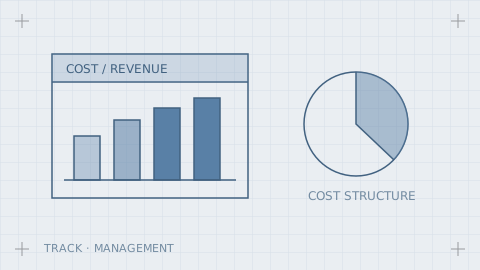
Cost accounting and the real price per m³, efficiency indicators and benchmarking, multi-year development plans, making the case for investment to the board and the municipal owner.
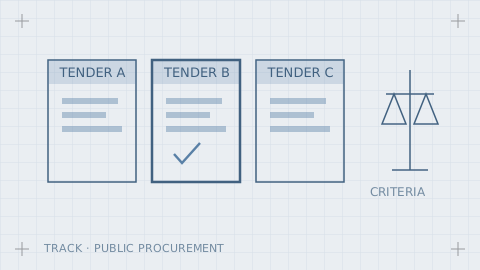
Writing a specification that does not end in a variation order, non-price criteria and life-cycle cost, evaluating tenders, and the appeal grounds that come up most often - and how to avoid them.
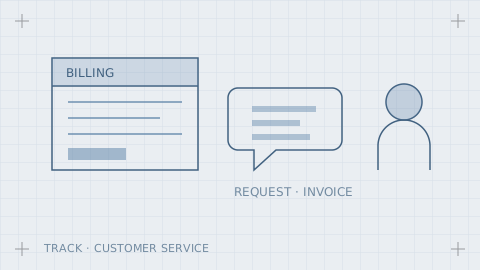
Customer contracts and enforcement, complaints and difficult conversations, debt recovery step by step, billing with remote meter reading, and communication during outages.
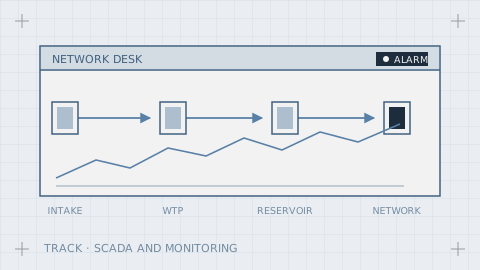
How to read a control room desk without drowning in alarms: thresholds and hysteresis instead of false reports, event priorities, on-call and escalation procedures, measurement archiving, and board reports built from the same data the operator works on.
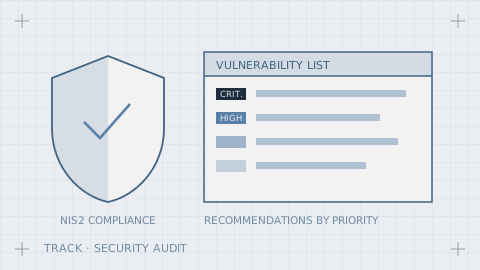
Water utilities are critical infrastructure, so NIS2 obliges rather than suggests. Inventory of systems and access rights, separating the office network from the technology network, backups that can actually be restored, an incident response plan and reporting duties.
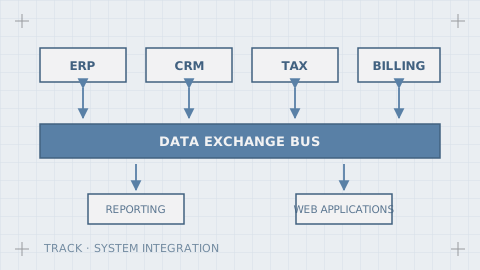
The most common digitisation problem is not “which system should we buy”, it is “why do these figures disagree”. We teach how to plan data exchange between ERP, CRM, tax systems and billing: which source owns which piece of information, how to reconcile balances and customer records, how batch integration differs from an API, how to write integration requirements into a tender, and how to test acceptance.
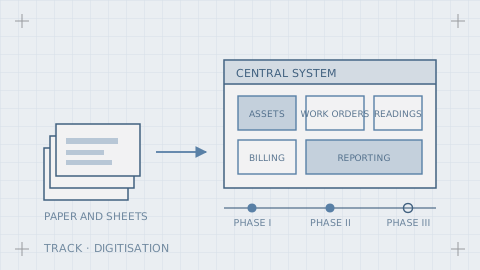
The track that closes the other seven: it turns knowledge of regulation, organisation and systems into a single plan of action. From paper to system - asset inventory, work-order and document flow, integrating billing with meter readings, selecting a supplier and writing requirements, and a realistic rollout plan split across budget years. For the people who have to plan it and defend the plan to the board.
These are the topics entering the programme first. We publish dates once the room and the trainers are confirmed - usually six weeks ahead. Leave your details against a topic and we will come back to you before we announce it publicly.
| Timing | Topic | Format | Location | Registration |
|---|---|---|---|---|
| Soon | Tariff application - preparing and defending it | Training | Bełchatów | Notify me → |
| Soon | Water law changes - what affects utilities | Webinar | Online | Notify me → |
| Soon | Non-price award criteria - workshop | Webinar | Online | Notify me → |
| Soon | Digitising a water utility | Training | Online | Notify me → |
| Soon | Tariffs 2027 - calculation and common errors | Webinar | Online | Notify me → |
| Soon | Debt recovery and the difficult customer | Training | Bełchatów | Notify me → |
| Soon | Security audit of your systems - where to start | Training | Bełchatów | Notify me → |
| Soon | NIS2 and critical infrastructure - what utilities must do | Webinar | Online | Notify me → |
Dates for the next edition are being finalised. Leave your details against a topic and we will let you know as soon as registration opens.
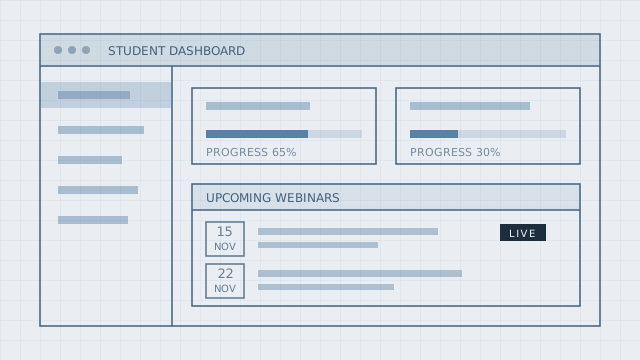
A training course ends on Friday; the competence is supposed to last for years. That is why we run our own course platform, Akademia Wodociagowca: live webinars, courses to work through at your own pace, working materials and certificates - all under a single company account. It is how we keep knowledge circulating around the sector instead of settling in one person's notebook.
Webinar count and people trained - sample figures, to be confirmed before publication.
Our trainers walk into the room straight from rollouts and advisory projects. The example on the slide has a date and consequences; it is not an illustration copied from a textbook.
Recordings, document templates and checklists stay on the company account. When someone leaves, the competence stays - the next person starts from the material, not from scratch.
A topic that comes up for the third time in a webinar chat or at the Wodociagowiec desk goes into the catalogue. The market writes the programme; we just put it in order.
One company account, many employees, and material available when it is actually needed - not only on the day of the course.
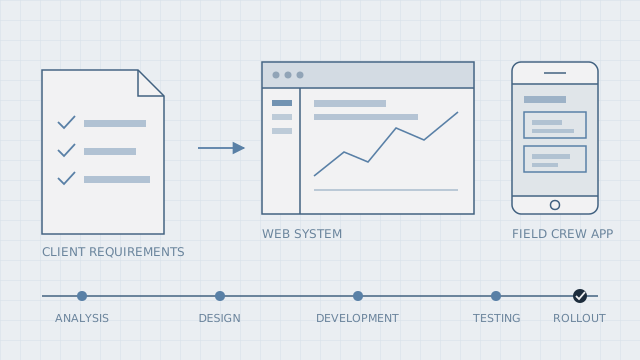
The course platform we run our webinars on, the Wodociagowiec portal and Gielda Komunalna are all our own builds. We do the same work for clients: analyse the need, design it, write it and hand over a working system. Turnkey, with no subcontractors. We also advise on large integrated system rollouts - on the buyer's side of the table, not the vendor's.
We started before “app” meant something on a phone. Since 2014 we have combined that with hands-on knowledge of the water sector, so nobody has to explain what a tariff, a meter reading or a service order is. We understand the domain and we write the code - a rare combination.
| No. | Item | Value | Notes |
|---|---|---|---|
| 01 | Experience in IT | 25+ years | From desktop systems to mobile applications |
| 02 | Engagement model | turnkey | Analysis, design, code, testing, rollout and support |
| 03 | Platforms | web + mobile | Browser, Android, iOS - one shared data set |
| 04 | Quote and schedule | up front | Fixed scope and deadline agreed in the contract |
| 05 | Rights to the code | client | Source code and documentation handed over in full |
| 06 | Advisory role | client side | Oversight of large integrated system rollouts |
| 07 | Rollout reach | PL and abroad | Well and pump operation systems, network monitoring |
Scope is agreed case by case - the terms above are our standard way of working.
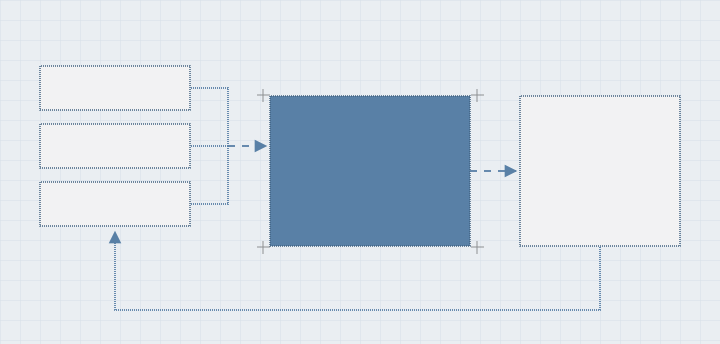
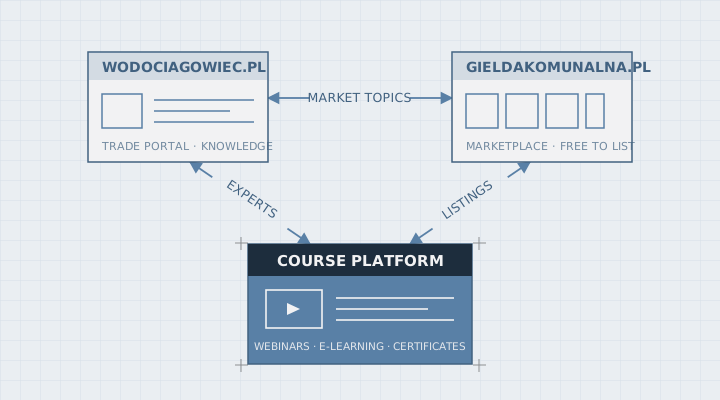
We do not start from a blank page. We run three services the Polish water sector uses daily, and they tell us what to teach. Readers' questions become webinar topics, listings on the marketplace show what the sector actually needs, and course participants meet the manufacturers and contractors they used to hunt for through word of mouth. The third service, our Akademia Wodociagowca course platform, sits at the centre of that loop - it is where the webinars and courses actually run.
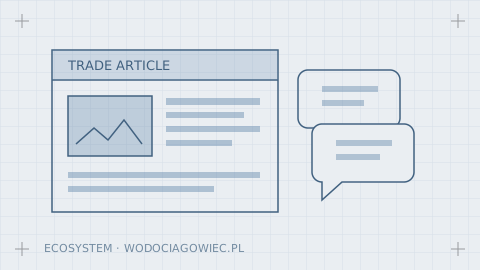
An industry portal for water professionals: technical and legal articles, operational cases, analysis of regulatory change, reader questions and expert answers. This is where we see which topics keep coming back - and build the webinar programme from them.
Go to wodociagowiec.pl →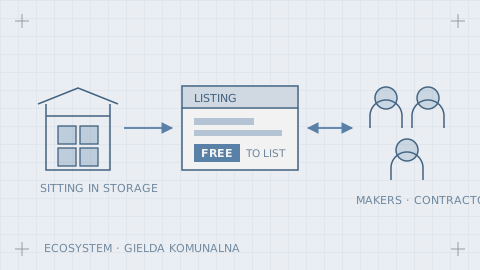
A new marketplace for the municipal sector. List, sell, buy or swap what is sitting in your warehouse - free of charge: surplus from completed projects, equipment replaced during upgrades, spare parts for machines nobody manufactures any more. It also brings together the manufacturers and contractors of a genuinely niche, specialist trade.
Go to gieldakomunalna.pl →A question that comes back on the portal for the third time in a month goes into the programme of the next webinar. We do not guess what the sector needs - we see it in the readership figures and in the questions.
Portal → PlatformWater and wastewater is a niche market: there is a handful of specialist manufacturers and contractors nationwide, each in a different region. The marketplace gathers them in one place, so nobody has to ask around.
Marketplace → Manufacturers and contractorsSurplus from a project two years ago sits there because throwing it out feels wrong and there is nobody to give it to. Someone a hundred kilometres away is looking for exactly that. The marketplace matches the two - no commission, no listing fee.
Warehouse → Second life“We came for tariff training and left with a work plan for the whole application.”
Training runs in Polish by default; English-language sessions and materials are available for closed courses on request. Write to us and we will come back within one working day.